Showing posts with label Michelle Fairchild. Show all posts

Sunday, June 7, 2015

Mojo Monday ~ Valie's Healing and Lizzie's Growing Family

Who are your ancestors?  Whose DNA did you inherit?  Have you done any researching or digging into your family's history?  Have you unearthed any interesting stories?   

Since February I have been sharing the story of my maternal second great grand aunt Elizabeth Talmer Roberts Shepherd.  She was the sister of my maternal great great grandfather Abel Roberts.  I chose Elizabeth "Lizzie", because in delving into family geneology I had come across a comprehensive written story of her life.  I was impressed by this young woman's courage and strength.  If you want to start at the beginning click here.   If you have been following her journey scroll down for the next installment of Lizzie and her family's journey.

Valie, Gilford and Bart
It was in about December of 1909 that Valie, one of Lizzie's daughters, began to feel ill. Her first symptoms were rheumatic pains in her joints which ached, so that she slept many nights with her feet propped up on the oven door for warmth, as she sat in a larger rocker. Early in April while on an errand for her mother Lizzie, she was caught in the rain and became thoroughly chilled. She spent several days in bed but finally was allowed to go back to school. On the last day of school there was a picnic and they were caught in a heavy rain. She became soaked and for the next few days was very ill. She had improved some when it was time for her mother to go into the mountains to cook for her brother and another man who were building homestead houses. Lizzie took Valie along thinking that the mountain air would do her some good. After a sold week of an earache while in the mountains Valie was returned home to the care of her sister Adaline, who was sixteen. Valie was fourteen at the time. Lizzie then went back to the mountains to cook for the men.

The third day Valie was home she began to feel worse and when her sister brought her lunch, Valie began to hemorrhage from the nose and mouth. Adaline was frightened and sent for the doctor and send Douglas Spencer to the mountains for Lizzie. It was almost dark when he started out and had about fifteen miles to ride on horseback over unfamiliar trails. Adding to his troubles, a blizzard came up and he became lost. Lizzie had already gone to bed in the camp when she heard someone calling out. Claude, nor anyone else could hear the calls, but nevertheless Lizzie had the men get up and light a lantern. They went outside and called out into the darkness. A nearly frozen Douglas Spencer heard the shouts and located the camp.

As soon as it was light enough for them to see they started back to Laurel. The doctor had been to see Valie who was still having violent hemorrhages. When Lizzie arrived he told her that he did not know what the problem was but thought that Valie should be taken to Billings, Montana to a hospital. Lizzie asked him if he thought an operation would be necessary to save her life. He told her he didn’t know since he could not diagnose the problem, but that it might be the means of saving some other life. Valie had lost so much blood that the doctor admitted he had little hope she could withstand the trip to the hospital. Lizzie told the doctor that if it was the Lord’s will that she die, that she wanted her to die at home. Early the following morning Valie had another hemorrhage, this being the eighth one. The doctor returned but said he had done all he could. He told Lizzie that she was dying and pulled the sheet up over Valie’s face as he left. Lizzie stood in the kitchen praying for her daughter, when a knock came on the door. There on the porch were two Mormon missionaries. They came in and talked to Lizzie and held a prayer circle in the kitchen. They then entered Valie’s bedroom. Valie who had been only semi-conscious for three days and unconscious all that day responded when one of the elders took her hand and asked if she would like to be administered to. She was able to respond that she would. In the blessing she was given it was promised that she would recover and become a mother in Zion.

Valie ended up recovering from her unexplained illness. The same missionaries who had visited her on her “death bed” returned one day and marveled at Valie’s recovery. They shared their story of how they had come into town the night before and had planned out their route for the next day. They had planned to go to the opposite end of town, but the next morning one of them had a strong feeling that they should go the other way. They had only gone a short distance when a neighbor told them that there was a Mormon family nearby and how the daughter Valie was very sick. They were the only Latter Day Saints family living there at the time. The doctor who had told several people that Valie would not live through the day later stated that he believed a higher power must have restored her health. Valie had no further symptoms of that mysterious illness. In later years after a few years of marriage and after several doctors told her she would never have a child, she went on to eventually raise a large family.

Edna and George Hanna lived for a while at Red Lodge, Montana, during this time. Addie came up from Laurel and visited with her sister. It was here she became acquainted with Scott Huffman. Later Scott came down to Laurel to visit her. It took them awhile to realize how much they cared for each other, but when they did, they became a very devoted couple. When Valie began to feel better in the fall, the Shepherd family moved to Red Lodge. They were there when Scott and Addie’s first child, a daughter named Thelma Huffman was born on October 11, 1910.

The following year her sister Edna and husband George Hannah had a son named Milburn Minor Hannah on July 21, 1911. Brother Claude and his wife Francetta Kelsey were also living at Basin City and their first child, a daughter named Grace Esther Shepherd was born on August 25, 1911. Francetta was a very young wife and mother, only fifteen years old. Her parents Benjamin Franklin and Bolettie Vance Kelsey encouraged her to remain with them that year while Claude worked at Thermopolis on a sewer line and later at Crosby, Wyoming in the coal mines. It was at Thermopolis that Valie met Jim Peacock. Claude invited him to join the family for Thanksgiving dinner. Jim had been born in England and enjoyed hearing the soft English spoken words of Claude’s family. Jim also found himself attracted to Valie and the whole Shepherd family. He spent the next ten years near and around the family, even as they moved about. While Lizzie was at Thermopolis in 1912 she decided to sell the ranch in Burlington. She sold the 160 acres homestead that the family had worked so hard to pay off for $4,000.00.

Earnest Wiggett, Lizzie’s oldest son, had taken his family to Olathe, Colorado and was farming there. After the ranch sold, Carl and his family also went to Olathe, as did Burton and Florence Prettyman. A man named Bill Tubbs who was an artist, architect, carpenter and wood craftsman also entered the picture about this time. He had many talents, but didn’t always put them to use and too often sought solace in the bottle. There was much good in Bill though and Lizzie could see this in him. She chose to accept him as he was. There was sometimes resentment in the family when it seemed Lizzie put Bill before her own children. Yet they also recognized that he treated all her children with respect. He taught Claude the carpenter trade, and Bart and Gilford also learned craftsmanship from him as they grew into manhood. Lizzie was past fifty years old when Bill came into her life, and they stayed together until her death.

In the spring of 1912 the Shepherd family went north to Lewistown, Montana. Lizzie rented a café on Main Street called the Lewiston Dining Parlor. Lizzie did all the cooking, while Laura Clark and Helen Bolden helped Valie wait on the tables. They ofte had fifty men to serve for meals. Claude was working with his tems for a steam shovel outfit. Bill Tubbs was building some homestead houses. Scott and Addie Huffman were living in Red Lodge, Montana. Scott was doing bookkeeping at the coal mine at Washoe. Their second child, a son named Everett Roland Huffman, was born on August 23, 1912.
Lizzie Roberts Diner Lewiston Montana
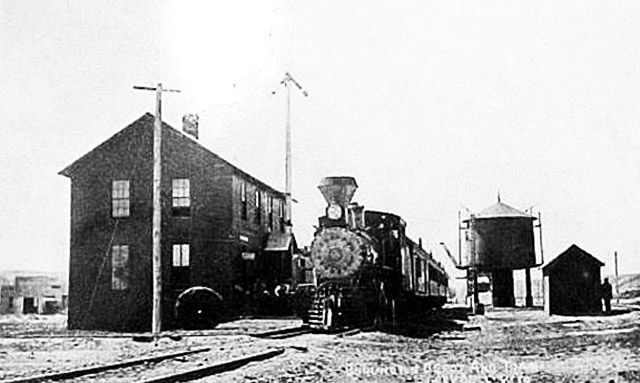
In the spring of 1913 the family went up to Denton, Montana. This was a new town about sixty mile northwest of Lewistown. The railroad was just being built into the town and plan were being made to build two large grain elevators. Lizzie felt there would be a lot of work there so she bought a piece of land that had a small old building on it and began to feed boarders.
Claude took a job hauling freight from Stanford where the railroad ended at that point in time. It was a muddy wet spring. The heavy mud on the unimproved roads rolled up around the wagon wheels and made it hard to travel very fast. Claude hauled lumber from Stanford to build the Denton Hotel. Bill Tubbs drew up plans which included a gas lighting system, which he planned, built and kept operating. He and Claude did most of the work. They moved into the hotel just before Thanksgiving, and it became the family’s source of income for the next five years. They had a pump house behind the hotel with a nice well. They had six bedrooms upstairs to rent. There was one bedroom downstairs. The old majestic range stood in the kitchen. Bill built a long convenient counter in the kitchen to serve from and made shelves above it for the dishes. He build a sturdy table on the other side of the room where the pump was located. They were always heating water for some purpose. There was a large reservoir on the old stove. Each room upstairs had a pitcher for water and a basin for washing in, but the wash tub had to be used for a weekly bath. The toilet facility was located on the back of the property, but each bedroom had its own covered convenience tucked under the bed.
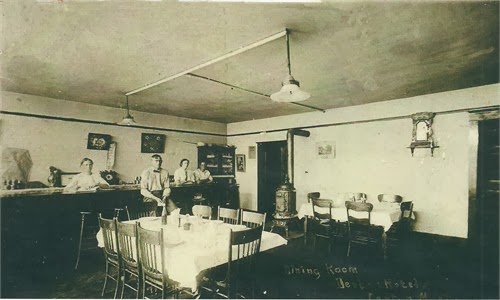
Lizzie Dining Hall Denton Hotel Denton Montana
While they ran the hotel Lizzie enjoyed the luxury of having someone else do the washing. She sent the sheets out weekly to be done. Lizzie was too busy feeing about a hundred men three meals a day. They served the food family style at five big table. Lizzie cooked big meals of meat, potatoes and gravy, and some kind of vegetable. She always made pie for lunch. In the early afternoon, Valie would bake two great big sheet cakes for supper, one white and one chocolate. Valie and Katie took turns waiting on tables. In 1914 Claude brought his family up to Denton and his wife Francetta also helped with serving. Valie and Francetta became close friends and little Grace, at about 18 months was the darling of the family.

Young Gilford, as a small boy, built a play house and a garage under the back stairway and put a neat fence all around it. These were good settled years for the family. Lizzie bought two other pieces of property here. Bill Tubbs built a five room house on one of these lots which they rented out for income and later sold to the blacksmith. He built a smaller two room house on the other lot where the family lived later for a short time. Edna came down and stayed with the family during the summer and George came down in the fall and worked on the construction of the bank building. Scott and Addie Huffman’s son Wilfred Scott Huffman added to the family when he was born on October 14, 1914.

To be continued....

Monday, May 25, 2015

Mojo Monday ~ Back On the Ranch

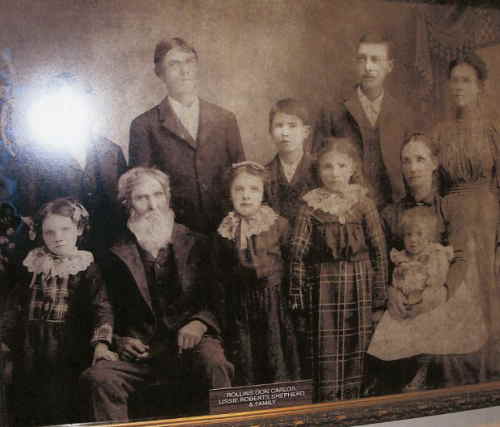
Shepherd Family Photo

Elizabeth "Lizzie" Talmer Roberts is the sister of my maternal great great grandfather.  In the process of doing genealogical research I came across a story written down about her.  Her story begins in when Lizzie was born on June 10, 1861 in Headless Cross, Worchestershire, England.  I have been sharing her story here in Mojo Mondays and if you want to start at the beginning you can do so by clicking here

...Meanwhile back at the ranch in Burlington, both of the young wives had recently given birth to baby daughters. The children born at the time were daughter of Carl and Annie, Bertha Adaline Shepherd, born on October 30, 1906 and daughter of Earnest and Mary, Mary Ella Wiggett, born on October 31, 1906.

Earnest and Carl brought their father by wagon from Burlington up to Belfry. That night the weather changed, a strong wind came first ahead of the storm. Claude and Edna spent most of the night trying to hold the ridge-pole steady to keep the tent from blowing away. The next day they went by wagons in a snowstorm to Bridger, Montana, about ten or twelve miles north. Here Laffe was laid to rest. His grave was marked with a large rock slab with the letter “S” painted on it. In 1973 his sister Valie would make a trip to Wyoming and Montana and she was able to locate a very efficient caretaker at the Bridger, Montana cemetery. He searched his records and located the grave site.

The storm continued very strong.   Lizzie took the girls, Bart and Gilford, and traveled back to Belfry on the train. Later the boys brought Rollins Don Carlos and the teams and wagons back to Belfry. When Earnest and Carl were ready to travel back to Burlington they left their father with his family. The family lived that winter in a tent on the bare ground. It was remarkable that those in the family made it through the winter.

That winter and the next spring was a very hard time for the family. In the summer, Claude and Burton Prettyman were able to get gobs on the railroad near Billings, Montana. When the Ringling Brothers Circus came to town, the kids saw the first circus they had ever seen. When the job was finished in the fall, the Shepherd family went back to Chance, Montana and the Prettyman family, to Red Lodge. In a short time, Burton Prettyman and three of the young boys had thyphoid. They were very ill and were taken to the hospital. The family recalled how during that summer Forrest Prettyman, who was just past five years old, had said to his grandmother Lizzie on several occasion, “When I die, will you bury me by my uncle Laffe?” Forrest died on September 18, 1907.

Lizzie and her family came for the funeral and stayed with Florence until Burton and the other boys were better. Later that fall the Shepherd and Prettyman families went down to Worland, Wyoming to work on the big Hanover Canal. The children did not go to school that winter. Joe and Earnest with Valie and Addie, would take the big cross-cut saw and with a couple of kids on each end, they would cut wood for both families. One day the four of them were playing down by the river and taking turns being pulled on a sled on the ice along the bend of the Big Horn River. The rope slipped out of Joe’s hand as Earnest and Addie, on the sled, headed for the swift open channel. Joe quickly slid out on his stomach to grab the end of the rope. His quick action saved them from plunging into the freezing icy river.

When the family moved to Laurel, Montana in the spring of 1908, Lizzie rented a house which the family called “The Coffee House.” The railroad was building a big ice house there and Lizzie took one room where she served family style meals to a few boarders. These were very hard times and work was hard to find, but there were quite a few men employed in building the big ice house. One of these was a young man named Douglas Spencer, who became very fond of Addie. When the ice house was about half built, it collapsed. One man was killed. Douglas Spencer dove into a ditch under the flowing, which saved his life, but his foot was caught and badly broken.

Another of the men who worked on this job and came to board with the Shepherd family was William Tubbs. William Tubbs had been born August 29, 1878 in Omaha, Nebraska. According to family stories, he had married there and was the father of two small children, a boy and a girl. The story goes that he came home one evening to find another man loading his household furniture and his family into a wagon. When he asked what was going on the man bluntly told him that he was in love with the wife and that they were leaving together. A fight followed and the story continues in that the other man was knocked backwards over the wagon tongue and died of a broken neck. Ill Tubbs left Omaha that night. Were he went on his westward journey, nor how long it was before he came to Laurel, Montana.

Later that year the family moved to a smaller house and Lizzie still continued to cook for a few men. Claude worked at the livery stable and there he met a man by the name of George Hanna. After George met Edna he became a frequent visitor of the family. Early in 1909 George and Edna went to Billings, Montana to be married. They moved into a small place of their own not far from where the family lived. It was here that they had their first child Mildred Fay Hannah on September 24, 1901.

Sometime in 1908 Earnest and Mary Wiggett left the ranch and went to Olathe, Colorado. Their daughter Millie Wiggett was born on January 1, 1909, but sadly she died the next year on December 22, 1910. Carl and Annie were still living on the homestead. Two daughters were born to them during this time, Lizzie Lora Shepherd on October 13, 1908 and Clara Shepherd on August 20, 1910.

Many people were out of work and the winter of 1909 and 1910 found many people facing very hard times. Claude and George worked at the liverly stable. Addie worked for a lady who ran the section house. Addie helped with the cooking and in the kitchen. Valie suffered from pains in her legs and her joints all that winter.

Earlier in the year their father used to take a couple of coal buckets and would follow along the railroad tracks to pick up coal. There was a curve in the railroad tracks a short distance from the house. Sometimes coal would fall off the train as it rounded this curve. Often the firemen would toss a few shovelfuls of coal off the train for people to pick up. One day in the summer father had gone for coal, but had become tired and sat down on the track where he proceeded to fall asleep. Addie notices that her father was gone just about the time she heard the train whistle. She ran out and pulled him off the track. She then gave him a lecture and asked him to stop going after coal. This was about the only time he ever left the house. He seemed more and more tired as winter and cold weather arrived.

Often the family was without good food that winter. As Christmas approached they were very bad off and had very little to eat. When their father got up on Christmas morning he went to Lizzie in the kitchen and told her he was going to die. He went over to a couch-like bed which they kept in the kitchen. He laid down, went to sleep and then died in his sleep. Rollins Don Carlos Shepherd died at age 79 on December 25, 1909. A heavy winter snow storm came up the day of his funeral, just as it had when Laffe was buried. Valie remembered the teams that pulled the hearse, and how several of the men stood on the side of the hearse to add their weight to keep it from tipping over in the heavy snow.

The family remained in very destitute conditions that winter. One of their boarders, a man by the name of Ezra King brought the family a twenty-five pound sack of flour, which was all the food they had in the house at that time. Malnutrition may have contributed largely to compounding the problems which beset Valie at this time, for it was in the sprint of 1910 that she suffered an illness which almost took her life.

To be continued....

Monday, May 11, 2015

Mojo Monday ~ Time of Change for Lizzie

ELizabeth "Lizzie" Talmer Roberts
Elizabeth "Lizzie" Talmer Roberts

Elizabeth "Lizzie" Talmer Roberts is the sister of my maternal great great grandfather.  In the process of doing genealogical research I came across a story written down about her.  Her story begins in when Lizzie was born on June 10, 1861 in Headless Cross, Worchestershire, England.  I have been sharing her story here in Mojo Mondays and if you want to start at the beginning you can do so by clicking here

It was a time of change for Lizzie too, and while these things affected her, it was in a different way. She was just past forty-three years old and still a strong and vigorous woman. She had fought with William Packard over the irrigation water. Packer insisted that Carlos had given the water right to him, and Lizzie insisted that he was not going to have it. She had used the water to irrigate five acres of wheat and had seen it come to a good harvest under her care. She would stand up for herself, so in the Spring of 1904, when the crop was coming along, she rented out the ranch land as pasture. Then she took the livestock and her six children and moved from the ranch into a house on the Prettyman place down by the river. She stayed here for a few months. Her husband was left in the care of Earnest Wiggett and his wife Mary. They moved back to the ranch and their first son Leslie Wiggett was born there on September 3, 1904.

Early in the Spring of 1904 Lizzie decided to leave Burlington. She had a covered wagon to carry a few belongings. She took a horse for Claude to ride and a pony, which Edna rode. They helped to drive the cattle and milk cows, which they also took. Lizzie’s son Carl was also very restless and perhaps hoped for a better start somewhere else or perhaps he felt his mother needed his help during this time. Lizzie, Carl, and Annie with her three young children, left Burlington together. They traveled across Wyoming that summer finding work where they could. Somewhere along Lander, Wyoming the children found lots of wild berries growing along the creeks and river.   They picked large quantities of the berries to use fresh and Lizzie and Annie made jelly as well. They moved on southward to Atlantic City, which was a very rough frontier town. They lived in a tent and the wagon that summer. Lizzie sold milk and butter. She baked bread to sell and took in washing from the miners there. Carl and Laffe took a job with their teams cutting and hauling cord wood and railroad ties. The man who leased them the land for cutting did not own the land and they were ordered to get off or be shot. The boys had the wagon loaded but were afraid to drive it out because of the threats. Edna at age twelve was not about to let that load be left there. She climbed up and drove the wagon down to the mill without incident.

Once again that summer, Edna kept the family from having trouble. Lizzie had been carefully saving the money she made so she could pay the mortgage on the ranch. She has nearly a thousand dollars and was keeping the money in a large trunk. One evening two very rough men came to buy break and she went to the trunk for change. When they got outside the tent, one man said to the other, “That old lady has plenty of money in that trunk. We will come back after dark and get it.” Edna happened to be standing where she heard them. As soon as they were out of sight she told her mother. Lizzie put the money into two small sacks and pinned them to the inside of Addie and Valie’s clothing. She told the girls if she was caught that they were just to keep on walking. The family went to the home of the Marshall for the night. When they returned to the tent in the morning, the trunk had been kicked open, the contents scattered about and the place torn up, but the money was safe. Lizzie took it to the bank that day and sent it off to Burlington to apply on the mortgage of the ranch.

Another story to add here is how Bart, who was not yet five years old, liked to dig through the trash near their tent, which happened to be near a saloon. One day he picked up a round object, but his sister Valie told him it was just an old poker chip and to throw it away. Bart was convinced it was as good as money and sure enough earned one dollar for it. He gave it to his mom to go with the other mortgage money and he liked to tell everyone how he found the last dollar to pay on the ranch mortgage.

The family stayed in Atlantic City until the fall of 1904. Carl and Annie’s first child, a daughter names Electra Shepherd was born there on September 20, 1904. Carl gave her the name of his beloved little sister who had died as a child. In the later Fall of that year, Carl and Annie went back to Burlington to the ranch. Earnest helped Carl build a two room house on the upper forty acres. The two young men, with their growing families, lives and worked together on the ranch for about five years.

Lizzie moved to Thermopolis, Wyoming that Fall. All the children went to school there that winter. Lizzie’s last child William Gilford Shepherd was born there on December 18, 1904. In the spring of 1905, Bart was ill with large abscesses on his legs. There were no miracle drugs in those days and infections were common. Lizzie could not cure them with home remedies, so she took him to one doctor who wanted to lance them. She was not satisfied with his quick diagnosis and took him to another doctor. He told Lizzie if they were lanced, the boy would never walk again. Lizzie took him home and made homemade poultices of soap and sugar to gather the infection. Finally they broke and drained. Bart was in bed most of that spring. When the family left Thermopolis in the spring, they made a bed in the back of the wagon for Bart. Valie had just completed a most satisfactory full year of school and enjoyed being Bart’s teacher. She taught him to write all the letters and when they ran out of paper they wrote on the side of a wooden box. They had some little “Buster Brown books” they had received when they bought shoes. The read and reread these stories, and also anything that had printed letters written on it. Valie was evidently a successful teacher for when Bart started school he was put right into the third grade where he could read with the best of the class.

The family returned to Burlington for a short time that summer, then Claude and Carl took a contract to bale hay on the Y.U. sheep ranch some distance west of Burlington, at a place called Pitchfork. The boys used a baler that was driven by horsed. They hooked the team to the baler, and then the team went around in a circle. The hay was put into the baler which pressed it into the shaped of a bale. A wooden block was dropped into the baler to regulate the length of each bale. Edna and Addie had the job of dropping the blocks between the bales. The bales were then tied with baling wire. They worked long hard hours, and one night Addie, who was very tired, dreamt that they were still working. She shouted out in her sleep, “Block Carl, block! This bale is a mile long now.” They baled a good many tons of hay that season. They piled the bales into long stacks. There were six or eight long stacks of these bales.

Lizzie spent several weeks of misery that summer with a big abscess under her arm. She could hardly mix bread or take care of the cooking for the hungry workers. Later that summer the family went to Bear Creek where Lizzie established a little store in part of their home.

In the summer of 1906 her son Claude went to Chance, Montana to work on a ranch. It was here that he first met Scott Huffman. Scott was recuperating from lung problems following pneumonia. His family had sent him to the farm of his uncle Onie Hall, to do light work and breath clean air. Claude and Scott became friends.

Early in September Laffe took some time off to go on a fishing trip. He went with a fellow named Ross Nixon. (Ross Nixon was married to Rose Clark, who had a sister named Laura Clark. His brother Claude would marry Laura many years later.) Laffe and Ross took the spring wagon and were gone several days. When Laffe returned home he was very sick. He asked Valie and Addie to unhitch the team and take care of them as he was too sick to stand up. He went right to bed and was very ill for many days. He had caught typhoid fever. After a while, he began to feel better. Lizzie decided that the water at Bear Creek was adding to Laffe’s problem, so they packed up and moved down to Belfry, Montana. Laffe did feel better for a while and would sit outside in the sun, but his strength did not return and he continued to feel ill, which gave cause for concern to his mother Lizzie and family.

Claude took a job hauling lumber that Fall. In handling the lumber, he got a big half-inch sliver in his thumb that appeared to go nearly to the bone. He tried to ignore it. One night he rode about six miles to visit his girl and when he got home he was in so much pain that he fell off the horse. A doctor came and lanced and drained the wound. Claude nearly had a case of blood poisoning as a result of that incident.

The weather stayed open and quite warm until late into the fall. Laffe would feel better for a while, then would take very ill again. One day he was sitting up and a neighbor brought over a plate of food. It looked and smelled good to him and he ate it all, seeming to enjoy it very much. In a short while he began to cough. His cough became worse and he began to hemorrhage. Soon he became violently ill and he died that evening. (Marcus De Lafayette Shepherd died at age 20 on November 14, 1906.)

Belfry, Montana was a very tine place with neither stores, nor a cemetery. Lizzie had to send Claude and Edna to Red Lodge, a trip or ten or twelve miles up over the mountains, to get a casket. When they got to Red Lodge, the store keeper sold them a coffin and clothing for Laffe to be laid away in. He also included a black veil for Lizzie to wear as was the custom of the day. When they got ready to start back, the stubborn old horse Kate balked as she often did. Claude was just about at the end of his patience. He picked up a 2 x 4 and gave her a beating. This caused the horse to kick wildly and Edna held the reins praying Claude would not be kicked in the head by the flying hooves. Finally the got the mare under control and made the trip back home safely. Lizzie notified the family at Burlington, and they began to prepare Laffe for burial.

To be continued.....
Shepherd Family Photo

Sunday, March 29, 2015

Mojo Monday ~ Better Days for Lizzie and Family

Nevada ship log showing Lizzie and family.
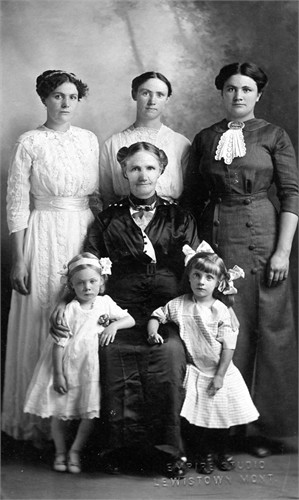
Lizzie with her daughters

The story of Elizabeth Talmer Roberts Shepherd continues.... (The beginning of Lizzie's story can be located here.)

It was in 1897 that Lizzie's children got their first chance to go to school.  The people of the community donated logs to build a 16 x 32 feet school house.  Reverend L.D. Thompson donated two acres of ground on which to erect the building.  It was covered with a dirt roof and was used not only for school purposes, but for other purposes by Mormons and gentiles alike.  In the winter of 1896 Elder William Packard called a meeting of the Mormon people to discuss the proposition of building a meeting house. This building was completed by 1897.

greybull1909

In this period when the Mormons were still in very poor circumstances, the chief engineer of the Burlington Railroad came to A.O. Woodruff and told him that he would like to give the people of this area twenty miles of railroad to build.  This section of railroad ran from Pryor Gap on the Crow Indian Reservation in Montana to Frannie, Wyoming.  Contracts were signed for twenty miles of grading, the price being 13 1/2 cents for earth, 24 cents for solid rock, and 50 cents per ton-mile for pipe haul.  Charles A. Welch, who wrote a history of the Big Horn Basin, was selected to do the railroad work and look after the commissary.  This was an answer to a prayer as it supplied the settlers with a source of income during the winter.

The next three years were quite good years on the ranch.  They continued to clear more land, to improve the canals and to plant more each year.  The crops of hay and grain were good, the family had a small garden, which Lizzie took care of.  The children picked wild berries along the river.  Some jelly was made and preserved.  The children would collect old beer bottles and such.  The tops were cut off the bottles by dropping a hot harness rind down over the bottle neck.  Then they were filed smooth across the top.  After they were washed and the jelly was poured and set, they were sealed by coating a piece of tablet paper with egg which and sticking it securely over the top.  Lizzie was a thrifty woman and made use of all the items of produce.  She made tomato preserve and a large stone jar was made full of pumpkin butter.  The children love the green tomatoes that Lizzie used to slice and fry.  After their lean years it now seemed that they had a very comfortable life.

Lizzie's daughter Florence gave birth to her second son on July 12, 1898 and named him Earnest John Prettyman, after her brother.  In the winter of the following year on December 18, 1899, Lizzie and her husband Rollins Don Carlos had another son and named him Bartley Roberts Shepherd.   Lizzie's oldest son Earnest Wiggett was now nineteen years old, son Carl Shepherd celebrated his fifteenth birthday on January 1, 1900, and Laffe was fourteen.  

Son Claude wrote in a story, "I was big enough then to go with my brothers to get timber."  The boys cut and hauled many loads of logs and started to build a four room house.  They laid logs up to the square (ready for a roof) at least two different times, the took the logs down to use for fences and corrals.  One day while they were working on the fence, Carl picked up a new hatchet that one of the neighbors had carelessly left.  New tools were rare, and Carl was pleased with his new find.  Lizzie saw him hide it in the sagebrush and knew it did not belong to them and made him return the hatchet to the rightful owner.

In the early spring of 1900 Florence and Burton Prettyman had their third son.  Burton Hazen Prettyman was born in Burlington on March 27, 1900.

In the fall of 1900 there was a lot of illness.  A man by the name of James Aaron Kinnamin came to Burlington.  He had left his wife and small child in Colorado, but had brought his four oldest children with him in a covered wagon.  Lon and Willard were in their early teens, Mary about twelve years old and Howard about ten.  When they arrive Lon was ill with diptheria.  Lizzie took in the washing for this family and although she used carbolic acid as a disinfectant in the wash water and in the dish soap, soon Earnest, Valie and Lizzie each had diptheria.  They were all very sick.  Lizzie sent Carl to buy a bottle of pure grain alcohol at the saloon.  She would pour a few drops of this onto a teaspoon with sugar and have the ill ones take it to cut the phlegm in their throats to keep them from choking.  Addie was then about seven years old and was very afraid of getting the illness.  She told her mother, "If I get it, I'll die."  So she ate sugar and alcohol, and also threw all the used spoons behind a chest of drawers.  Fortunately she did not get sick.

Rollins Don Carlos Shepherd had his seventieth birthday in the winter of 1900.  He continued to work on the ranch with the help of Earnest and Carl.  They were still clearing sage brush and still extending the canal system across their land.  In the year of 1901 they had a good crop of alfalfa that grew as tall as a horse.

In the fall Laffe and Claude walked about three miles to school.  Enda, Addie and Valie also walked to school with them.  Valie can remember taking a short cut through the fields and down along the big canal.  Sometimes they would go over to the Kinnamin house with Mary for lunch. They had rented a small house in Burlington.  Although they had no woman to care for them, the house and the children were neat and clean.  The children enjoyed these growing up years, and many family stories come from this time.

To be continued.....

Family-Stories

Do you know any old family stories?  How far back do they go?  

Consider asking grandparents, parents, aunts and uncles about stories they may know.

Monday, January 19, 2015

Mojo Monday ~ Furry Family

Once upon a time (around September of 1996) a stray can showed up on my front porch.  He was adorable with a little round head, bright green eyes and the softest short coat of fur ever.  The little guy adopted me and basically took up residence at the house.  Here is a photo of adorable Oscar with those bright green eyes joining in the pumpkin carving fun at Halloween.

Bandito Mommy - Oscar
Matriarch Oscarina

Next spring I suddenly noticed some behavioral changes in Oscar and quickly realized that Oscar was a female cat and was indeed pregnant.  Now being called Oscarina I took good care of the expectant mama.  One day while at work I received a call from a roommate stating she thought Oscarina was going into labor.  I left work early and arrived to find her in labor.  From what I had heard most cats tend to seek out private and hidden areas when it came time to deliver.  Not Oscarina.  She was in the bed I had prepared for her but she didn't want to be left alone.  She even rolled on her back and I rubbed her belly a little.  She had me right there by her side as she delivered four kittens into this world on April 8, 1997.  It was amazing to watch as she birthed all four and then went into mama mode, cleaning and caring for them.

Oscar and kittens
Mama kitty with her 4 kittens.

Each of the kittens had a unique appearance.  One kitten looked like he had the Phantom of the Opera mask across its face and was named Phantom.  A little black and white kitten had a cute little white goatee type look and we named it Foo Man Chu.  The third looked a bit like a racoon with a mask around the eyes and we named it Bandito.  The fourth didn't really get a name that stuck and as it would happen she was the one adopted by a friend of a friend.  If I remember right after all these years I think the plan was to name her Daisy.

As it worked out only one of the kittens was a boy, that being Phantom.  Foo Man Chu a little girl kitten, ended up being nicknamed Fooey.  Bandito, also a girl , continued to be called Bandito.  About 6 weeks or so after the kittens were born a friend found an abandoned kitten and brought it to me to add to the family.  This new kitten dubbed Cracker came with some issues but mama kitty and the other kittens took her in.  Mama would turn on her once or twice when Cracker would become aggressive about food with her other kittens.  Sadly one day mama kitty came limping into the house and proceeded to die.  All we could think is that she had been side swiped by a car and had sustained internal injuries.  We gave her a proper burial and mourned her passing.

Phantom and Bandito
Phantom and Bandito

The kittens continued to grow into healthy young cats.  Bandito was the kitten I chose to keep for sure.  One of my nieces ended up adopting handsome Phantom.  Cracker, the step-sister, also found a new home.  Little Fooey stayed with me, but was always a skittish, so unlike her confident and friendly siblings.  I now think Fooey was just waiting to find her human soul mate.  She did finally find him when she met my dad. That little thing claimed him as her person and my dad fell in love with her in return.

The years passed and it was nice that most had gone to family so I could stay up-to-date on how they were doing.  As these things happen eventually my niece's Phantom developed a cat illness and passed away.  About two years ago my dad's precious Fooey showed signs of illness.  He took her into the vet and learned she had some serious mouth issues going on.  They recommended mouth surgery and my dad proceeded with the treatment.  Fooey had a couple of teeth extracted and the vet thought there might be a mouth cancer at play.  Fooey never fully recovered and passed away three months later.

Queen Bandito
Queen Bandito

My matriarch Bandito has been the ruling kitty queen in our home for many years.  When we added our dog Shanti to the family in 2003 she begrudgingly accepted the new addition, but made it clear that she rules.  Shanti to this day will roll over and be submissive to Queen Bandito.  When our twin daughters were born I wasn't sure how Bandito would respond.  She ignored them for a few years, but when they developed good petting skills she finally gave them stamps of approval.  She used to jump up on the bathroom sink for her food and water.

Bandito chilling with the twins.
Bandito turned 17 years old in April of 2014.  A few years ago she began to develop a cloudy cataract in her one eye.  We have also made various adjustments in the home over the years and recent months to make accommodations for her.  As a strong cat she used to jump up onto the bathroom counter to eat and drink her water.  This kept the dog from scarfing down the cat food. Eventually she didn't want to jump high anymore, so we put a kitty door in the bathroom door for her.  In recent months she didn't want to use her cat box with the lid on, so I removed and then bought a smaller box with a lower lip for her to step over.  We also took off the kitty door flap because it seemed to be bugging her.
Bandito at 16 years old
About a month ago she appeared to have an episode of some sort.  Maybe a seizure or min stroke.  Yet after a short pause she was back to normal.  Except for losing some extra fur around the house.  Then this last week things turned suddenly.  She wanted to hide in a closet and I finally noticed a strong disagreeable order coming from her.  I googled a few things and grew concerned it might be renal kidney failure.  Just this past Friday we took her to the vet.  The examination of her mouth revealed a couple bad teeth and a horrible mouth infection.  They took blood and urine to test, gave her an antibiotic shot that would last for two weeks to help with the infection, and suggested having her come back in when she was a little better for surgery to extract some teeth.  We left the vet unsure of the outcome.  When they called with the lab results it was surprising for a cat her age that there wasn't anything significant to be concerned about.  Yet it also became clear that at her age the infection and tooth issues could be very serious.  When I heard about her sister's results after mouth surgery I grew more worried.  I was questioning whether to put a cat her age through such an ordeal.  My dad recommended to not do it.

Yesterday and today I have watched my beloved Bandito grow more listless.  She has been refusing food for about 48 hours now.  I have been able to get her to drink some water by bringing it to her bed.  I hold her for stretches of time.  She purrs and cuddles in tight with me.  She lets me pet her all over and brush her.  She doesn't indicate she is in pain, even if I pet her near her chin and mouth, which is good.  She just looks so tired and listless.  She has tried walking, but is wobbly.  I wonder if the time has arrived for her to pass on.  Every couple of hours I tear up and cry.  Like right now.  In finishing up this posting I just want to go and get her and cuddle her close.  Not knowing if it will be the last time.
Me and Bandito
Me and Bandito
Bandito has been in my life for nearly 18 years.
I have been her person since the day she was born.
This fur kid has been such an important part of my life.
She will be forever in my heart.


Do you have fur kids?

Are there fur kids who have passed on
that will remain in your heart forever?(I had a cat named Holly who lived to be 18 years old too.
She holds a special place in my heart too.  I still have photos of her.)


We track the lineage and ancestry of humans.  
What would it look like if we tracked the
lineage of our furry family members?
(I know for me it feels very special to have know Bandito's mama
and to have been there when she was born.)

Monday, January 5, 2015

Mojo Monday ~ Looking Back & Looking Forward While Staying Present

William Roberts and Sarah Briggs Family
Maternal great great grandparents William Roberts and Sarah Briggs and children.

Looking Back

lin·e·age

ˈlinēij/
noun
  1. 1.
    lineal descent from an ancestor; ancestry or pedigree.
My blog writing, besides coming from those stories that inspire me personally and topics that I wish to share with others, is also sometimes informed by my connection with my Cosmic Cowgirls tribe.  My writing appears not only on my personal blogs, but also on Cosmic Cowgirls member web sites.  Over on the Rodeo of the Soul we are going to be exploring the theme of Lineage.  When I began delving into my own personal ancestry research about a month ago I had no idea that this was part of the new year plan.  It is rather serendipitous how things are falling into place.  

In light of this theme there will be more exploration of ancestry in the coming months, yet it won't be entirely focused on genealogy per se.  When I think of lineage in broader terms, beyond my own family tree, I think of honoring the wisdom of all women (and men) that came before.  I think of a video I recently watched of Bill Moyers interviewing award winning writer Ursula Le Guin who is about 85 years old now and the wisdom she shared.  I think of suffragists, feminists, women historians, activists, artists.....and onto the legendary work and impacts we are leaving in our wakes for the women and girls to follow us.  There is much to explore in the coming months.  

Looking Forward

At the beginning of a new year most of us not only look back at year we just wrapped up.  We also look forward to the new year, perhaps with dreams, goals and resolutions in mind.  Here are brief introductions to several articles that offered some thoughtful ideas for looking forward to the new year ahead. 

Beyond Carb-Cutting: Resolutions After A Trauma — Sleep, Play, Love - I especially love the simplicity of these heal-the-trauma resolutions and wonder how life might flow if these were your most primal goals for the year?  (Click the link for the full article.)

1. A restful sleep
2. Play, Sing, Dance  

3. Love the One Who Is With You 
4. Be In Nature
5. Ban Perfection (though I might tweak this one to Embrace Imperfection)

2 Choices That Can Make This Next Year The Best Year of Your Life - A fan of the wisdom of Dr. Margaret Paul and her Inner Bonding newsletters and program I found her two suggested choices to be sound advice - Gratitude and Intent to Learn.  (Click the link for the full article.)

If 2014 Tried You or Tested You, Do This - If 2014 was a hard year for you I encourage you to click on over for a visit to this article.  It has the ability to shift perspective.  I especially loved the passage below.  (Click the linked title to access the original article.)

"I believe 2014 was not your worst year, but possibly your greatest.

Your Year of Greatest Strength
Your Year of Greatest Faith
Your Year of Greatest Hope
Your Year of Greatest Patience
Your Year of Greatest Risk
Your Year of Greatest Determination
Your Year of Greatest Courage"

10 Ways To Live Simply In 2015 - Inspirational and thoughtful descriptions of ways to simplify.

Staying Present

Simple and wise words from Maya Angelou.

If you must look back Maya Angelou

Have you read any inspirational articles that you'd like to share about in the comments?

What are your thoughts about looking back, looking forward and staying present?