Monday, April 27, 2015

Mojo Monday ~ Lizzie's Aging Husband

Nevada ship log showing Lizzie and family.
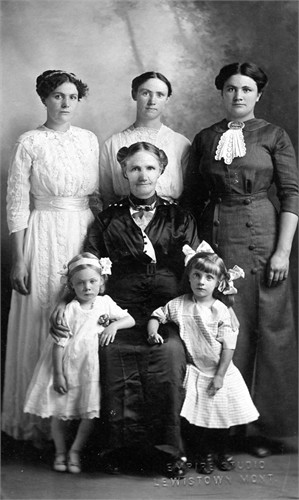
Lizzie and her daughters.
The story of my maternal great great grandfather's sister Elizabeth Talmer Roberts Shepherd continues….   (The beginning of Lizzie’s story can be located here.)

Now at a time when things are going along quite well for the new community and life has become a bit easier for most of them, it is sad to report that things were not going that well for the Shepherd family.  As Lizzie's husband Rollins Don Carlos Shepherd advanced into his seventies he became more and more irritable and unpredictable in his behavior.  One evening Florence and Burton Prettyman stopped by the Shepherd Ranch and were caught there in a heavy rainstorm.  They moved a straw tick from their wagon and prepared to stay over night.  Sometime during the night, father got up and was going to set the house afire.  When Burton took hold of him and spoke to him he did not even remember that Burton had been there earlier.  Burton put him back to bed and talked quietly to him for awhile.  Often after this, the children would carry their straw ticks out and sleep in the haystack during the summer weather.

About this time Carl had a very bad attack of boils.  He had three or four large boils on the back of his neck.  They were very sore and made him hurt all over.  He had stopped work and come into the kitchen and sat down in a chair feeling very ill.  In the meantime the calves got out of their pen and in with the cows and were nursing all the days supply of milk.  When father saw this he became enraged and rushed into the house to get Carl. He was carrying his irrigation shovel.  Carl saw him raise the shovel, mother yelled, and he jumped out of the chair just as his father brought the shovel down with such force that he split the chair in half.

Another day Rollins Don Carlos came into the house from the fields and went to the water bucket for a drink, but the bucket was empty.  Lizzie was sitting at the sewing machine and did not get up.  He took the bucket and went to the irrigation ditch for water.  When he came back he sat the bucket down and took a drink.  Then he took the heavy water dipper and began to beat Lizzie over the head with it.  Her cries brought Carl on the run from the barn with the pitchfork.  He told his father to quit or he would use the fork on him.  Rollins Don Carlos knew that Carl meant it.  Carl and his father got along well for the most part.  It was Carl who stayed and cared for him longer than anyone.

Late in the summer of that year Lizzie's son Laffe and a man by the name of Will Hawkins went over near the Yellowstone area and worked on a cattle ranch for that fall and winter.  Laffe got very homesick and wrote a poem, which he mailed home, to his mother.

I wish I had a clean shirt
I wish I had some shoes
I wish my little grey horse was fat
and I didn't have the blues.
I would go back home again
and there I would remain,
I never would punch cows
for the old L.C. Ranch again.

With two of the older boys away and only Carl to help him with the ranch work, Rollins Don Carlos became very discouraged in the fall of 1903.  He arranged to mortgage the ranch for a thousand dollars and decided to make a trip back to Beaver, Utah where his brother was living.  Before he left he went to a lawyer in Burlington and had a legal paper drawn up conveying all the personal property, farm equipment and livestock to Lizzie.  Their daughter Valie also believed that he had a formal bill of divorcement drawn up at this time.  Lizzie sewed the money into his underclothing and the boys took him by wagon to Basin, where he took the train to begin his journey to Beaver.  Rollins Don Carlos was happy to see his brother again and remained with him for several months.  He was still in Beaver when his brother Marcus Lafayette Shepherd had a heart attack and fell from a load of logs on February 5, 1904 at the age of nearly 80 years.  From a book on Beaver history, J. F. Tolton said of him "Marcus L. Shepherd: Philanthropist, Church Man - One who loved God adn served his fellowman."

When their father returned to the ranch in the early spring of 1904, he brought a velvet bonnet for each of the little girls and a China doll.  Edna got a brown bonnet, Addie a red one and Valie a blue one.  Not long after though Edna's had her taken by some older boys to tease her and they dropped it into the outdoor toilet.  The China dolls that Edna and Addie had, each had back hair that was painted on.  Soon Claude ran one of these through the cog wheel on the wringer of the washtubs.  Claude was always full of mischief.  he loved to get the key to the big eight day clock that hung on the wall.  he would change the alarm and set it to go off in the middle of the night.  Mother tried to keep the key hidden and often scolded him for his pranks, but he did not change.  The doll that Valie had was a smaller doll with real blonde hair.  She cherished this doll until she was past twenty year sold.  Then one day while she was cleaning out her trunk and had laid it on the bed, Claude came into the room and up to his usual mischief picked up a marble and flicked it at the doll.  The marble struck the doll's head, causing it to break all to pieces.  Valie felt very bad about it for she had kept it for so many years and it was the only keepsake she had from her father.

Sometime early in the year of 1904 Carl Shepherd, age 19, married Marry Anna Montana Abercrombria (Caldwell) who was born December 18, 1876.  She was 28 years old. Annie had come to the area with her parents, but she was living in a small house on the place just below the Shepherd placed.  Annie had been married to James Caldwell and had four children.  They were Melissa Caldwell (who had died prior to their marriage), Brazilla Caldwell, who was about 8 year sold, James Caldwell, who was about 6.5 years old and Ira Caldwell, who was still a baby.  Carl left the ranch and moved to a small house with Anie and her family sometime in the early part of 1904.

Rollins Don Carlos Shepherd was now past 74 years old and he was tired in body and spirt.  He had been saddened by the passing of his brother and could feel that his own years were limited.  He did not have a great deal to show for all his years of hard labor.  He had mortgaged the ranch and signed away the livestock and all the farm equipment to his wife.  The two boys, Earnest and Carl, who had worked so hard with him on the ranch for ten years had left to establish homes for themselves.

**It is believed that if the Shepherd families had combined their resources and gone ahead to homestead and to acquire more land in this fertile area, that their lives might have been very different.

However it was a time of change for Lizzie too.  She was just past 43 years old and still a strong and vigorous woman.  To be continued......

Sunday, April 12, 2015

Mojo Monday ~ More of Lizzie's Family Stories

Nevada ship log showing Lizzie and family.
Lizzie and daughters

The story of Elizabeth Talmer Roberts Shepherd continues....   (The beginning of Lizzie's story can be located here.)

One humorous story concerning the three little girls happened about this time.  In their Sunday school attendance they had been hearing much about the power of prayer.  The greatest hope of these three little girls was to have a fully equipped playhouse of their very own.  They knew that their folds did not have any way to provide them with such a luxury, so they decided to make it a matter of prayer.  They swept and cleaned a place under a large tree for the playhouse to be placed.  Then they set about to pray.  They prayed and watched, and often got up real early to see if their prayers had been answered during the night.  They even imagined that each cloud might have a playhouse hidden away inside it.  One afternoon the folks went to town for groceries and the girls were left with an older brother.  They wanted until earnest had gone about his work, (or so they thought), then they knelt down around the big wood box in the kitchen and prayed for the playhouse.  They each took a turn praying in a most fervent manner.  When it was Addie's turn to pray, she brought her fist down on the wood box and said, "And I pray that our playhouse will come down, plunkety, plink, flunkety, plunk."  Outside, Earnest and his friend, who had been listening to them, were doubled over with laughter.  And of course the story got passed around the family.  Soon the girls decided that a playhouse was not the thing to pray for.  But in later years, they enjoyed telling and retelling this story on themselves.

But Edna did have one of her childhood prayers answered in a very dramatic way, and it always strengthened her to remember it.  One day the family was getting ready to go to town.  The children were not often taken along, but this day they were told they could go.  So everyone hurried around to get ready, but they could not find the baby's shoe.  After looking everywhere else with no success, Edna decided that it must be in the bed covering so she carefully shook them out but to no avail.  Not knowing where else to look, she crawled in under the quilts and began to pray that she might be able to find the shoe there.  In a few minutes she crawled out to look on the top of the covered, but there was no shoe.  Then she dived right back down under the covers again, and began to pray that much harder.  They next time she came out to look, there was the shoe, as she had prayed that it would be, on the top of the quilts.

Edna had a firm testimony that prayers could be answered.  One summer day about this time the girls were amusing themselves at a game.  Lacking toys for fun, they had turned a wash tub upside down in the yard.  They would take turns crawling under it while the other two beat a good drum rhythm on the top of the tub.  The noise soon became very annoying to their father and he shouted for them to stop the banging, but they were having such sun, they paid little attention.  Valie was under the tub and Edna and Addie were beating good strong strokes, when their enraged father came around the corner carrying his pitchfork.  The girls were fearful of their father's temper.  Valie stayed right where she was under the tub, Edna ran as fast as she could and hid between the house and the cellar.  Addie took another route and sneaked through a hollow log and into the house where she stayed under the bed until her mother got back home.

Another day soon after this, Addie and Valie decided that they would run away from home.  They had crossed their own fields and gone through the fence down on Corn's place and were hiding in the sagebrush.  When they saw their mother running towards them with Bart under her arm, Valie said, "Oh, we better run. If she catches us she will give us a good whipping."  But Addie felt differently, "No," she said "We had better go back, something is wrong." And something was wrong.  Lizzie had been scrubbing the floor with lye water.  She had set the can and measuring spoon on the table and Bart who was just beginning to crawl had gotten into it.  Lizzie quickly washed out his mouth again and again. Although the lye had burned his lips and the inside of his mouth quite badly, he was not seriously harmed.

Valie can remember going to visit her sister's family one summer day.  Florence had taken a large empty wooden box and spread a quilt onto it for a playpen for baby Burton.  As Valie bent over to say hello to the baby, she saw there was a large snake in the box with him.  They quickly scooped the baby out and were relieved that it was only an old blow snake.

The family of Florence and Burton Prettyman also continued to grow.  The following children were born to them in the next few years:  February 11, 1902 ~ Forest Mansford Prettyman Burlington, December 27, 1903 ~ Sarah Talmer Prettyman, April 13, 1905 ~ Leonard Murrel Prettyman.

Crops continued to be good on the ranch.  After the spring planting was done, Earnest and the other boys would take jobs hauling freight to bring in extra money.  They hauled the first telegraph wires, cross arms and insulators from Cody down to Thermopolis, Wyoming.  Claude went along with earnest on this job.  In the Spring of 1903, Earnest hauled freight quite frequently to Thermopolis and began to save most of the money he was making.  For Earnest had decided to get married and he needed the money for a wedding stake.  One June 8, 1903 Earnest Wiggett married Mary Golda Kinnamin, daughter of James Aaron Kinnamin and Eliza York.

Earnest was twenty-two that year and Mary had just turned fifteen, having been born June 3, 1888.  They rented a small place further north of Burlington and went there to live.  Valie can remember a small tin trunk that Mary kept clothes folded in.  They had no closet, but Mary always kept her house very neat and clean.

Pioneer Day!

One of the highlights of the year for all the populations of the Burlington Ward was the 24th of July Celebration.  (Pioneer Day is an official holiday celebrated on July 24 in the state of Utah, with some celebrations in regions of surrounding states originally settled by Mormon pioneers.)  The youngsters looked forward to this for weeks.  It was a full day of fun.  There were horse races, foot races and for the boy, sack races and three legged races.  They had a ball game going all day and other games for everyone to enjoy.  A long table was set up under the shade of the bowery and the lunches the ladies had brought were put all together on this big table at noon.  There was fried chicken, potato salad, corn on the cob, slices of tomato, and the ward furnished a large barrel of lemonade, which was a treat for the young children.  There there were all kinds of cakes and pie for dessert.  It was a great day of good food and good fun for all.  Later in the afternoon when everyone was resting from the games, Claude and Eugene Praetor began to fist fight.  As Eugene was to remember years later, "Not because we were mad, we were the best of friends, but just to entertain the group."  Valie remembers that one of the ladies looked up at the boys and said, "Who is fighting?"  Mrs. Praetor replied, "Oh, it's my Gene and that Shepherd kid."

To be continued....

When working on your own ancestral research consider this suggested list  of questions to ask parents, grandparents, great grandparents, aunt and uncles.

Sunday, March 29, 2015

Mojo Monday ~ Better Days for Lizzie and Family

Nevada ship log showing Lizzie and family.
Lizzie with her daughters

The story of Elizabeth Talmer Roberts Shepherd continues.... (The beginning of Lizzie's story can be located here.)

It was in 1897 that Lizzie's children got their first chance to go to school.  The people of the community donated logs to build a 16 x 32 feet school house.  Reverend L.D. Thompson donated two acres of ground on which to erect the building.  It was covered with a dirt roof and was used not only for school purposes, but for other purposes by Mormons and gentiles alike.  In the winter of 1896 Elder William Packard called a meeting of the Mormon people to discuss the proposition of building a meeting house. This building was completed by 1897.

greybull1909

In this period when the Mormons were still in very poor circumstances, the chief engineer of the Burlington Railroad came to A.O. Woodruff and told him that he would like to give the people of this area twenty miles of railroad to build.  This section of railroad ran from Pryor Gap on the Crow Indian Reservation in Montana to Frannie, Wyoming.  Contracts were signed for twenty miles of grading, the price being 13 1/2 cents for earth, 24 cents for solid rock, and 50 cents per ton-mile for pipe haul.  Charles A. Welch, who wrote a history of the Big Horn Basin, was selected to do the railroad work and look after the commissary.  This was an answer to a prayer as it supplied the settlers with a source of income during the winter.

The next three years were quite good years on the ranch.  They continued to clear more land, to improve the canals and to plant more each year.  The crops of hay and grain were good, the family had a small garden, which Lizzie took care of.  The children picked wild berries along the river.  Some jelly was made and preserved.  The children would collect old beer bottles and such.  The tops were cut off the bottles by dropping a hot harness rind down over the bottle neck.  Then they were filed smooth across the top.  After they were washed and the jelly was poured and set, they were sealed by coating a piece of tablet paper with egg which and sticking it securely over the top.  Lizzie was a thrifty woman and made use of all the items of produce.  She made tomato preserve and a large stone jar was made full of pumpkin butter.  The children love the green tomatoes that Lizzie used to slice and fry.  After their lean years it now seemed that they had a very comfortable life.

Lizzie's daughter Florence gave birth to her second son on July 12, 1898 and named him Earnest John Prettyman, after her brother.  In the winter of the following year on December 18, 1899, Lizzie and her husband Rollins Don Carlos had another son and named him Bartley Roberts Shepherd.   Lizzie's oldest son Earnest Wiggett was now nineteen years old, son Carl Shepherd celebrated his fifteenth birthday on January 1, 1900, and Laffe was fourteen.  

Son Claude wrote in a story, "I was big enough then to go with my brothers to get timber."  The boys cut and hauled many loads of logs and started to build a four room house.  They laid logs up to the square (ready for a roof) at least two different times, the took the logs down to use for fences and corrals.  One day while they were working on the fence, Carl picked up a new hatchet that one of the neighbors had carelessly left.  New tools were rare, and Carl was pleased with his new find.  Lizzie saw him hide it in the sagebrush and knew it did not belong to them and made him return the hatchet to the rightful owner.

In the early spring of 1900 Florence and Burton Prettyman had their third son.  Burton Hazen Prettyman was born in Burlington on March 27, 1900.

In the fall of 1900 there was a lot of illness.  A man by the name of James Aaron Kinnamin came to Burlington.  He had left his wife and small child in Colorado, but had brought his four oldest children with him in a covered wagon.  Lon and Willard were in their early teens, Mary about twelve years old and Howard about ten.  When they arrive Lon was ill with diptheria.  Lizzie took in the washing for this family and although she used carbolic acid as a disinfectant in the wash water and in the dish soap, soon Earnest, Valie and Lizzie each had diptheria.  They were all very sick.  Lizzie sent Carl to buy a bottle of pure grain alcohol at the saloon.  She would pour a few drops of this onto a teaspoon with sugar and have the ill ones take it to cut the phlegm in their throats to keep them from choking.  Addie was then about seven years old and was very afraid of getting the illness.  She told her mother, "If I get it, I'll die."  So she ate sugar and alcohol, and also threw all the used spoons behind a chest of drawers.  Fortunately she did not get sick.

Rollins Don Carlos Shepherd had his seventieth birthday in the winter of 1900.  He continued to work on the ranch with the help of Earnest and Carl.  They were still clearing sage brush and still extending the canal system across their land.  In the year of 1901 they had a good crop of alfalfa that grew as tall as a horse.

In the fall Laffe and Claude walked about three miles to school.  Enda, Addie and Valie also walked to school with them.  Valie can remember taking a short cut through the fields and down along the big canal.  Sometimes they would go over to the Kinnamin house with Mary for lunch. They had rented a small house in Burlington.  Although they had no woman to care for them, the house and the children were neat and clean.  The children enjoyed these growing up years, and many family stories come from this time.

To be continued.....

Family-Stories

Do you know any old family stories?  How far back do they go?  

Consider asking grandparents, parents, aunts and uncles about stories they may know.

Sunday, March 15, 2015

Mojo Monday ~ Tragedy Strikes

Nevada ship log showing Lizzie and family.
Photo of Lizzie and her daughters.
When we last left off with the story of Lizzie an accident had just occurred.

On the family's return trip from Billings, Montana the older children were walking along the roadside picking flowers.  Five year old Electra who was riding in the wagon decided she wanted to pick flowers too and while climbing down, slipped and fell.  Her dress caught in the brake block and threw her under the wagon.  The heavy wagon rolled over her body and her back was broken.  The family went back to Billings for a doctor, but he said he could do nothing for her.  Her father, Rollins Don Carlos, wanted to get back to the ranch, so they made a bed for her in the wagon and started out.  Their travels took them through the Crow Reservation at Pryor, Montana.  The Crow tribe did what they could to ease her suffering, but after a few days she died on June 27, 1894.  She was laid to rest there on the reservation with a service spoken by a Catholic priest.  Lizzie did not feel good about the rosary beads and the cross he put into her little coffin and she removed those before she was buried.

The family finally returned to Burlington in the month of July.  Young Earnest, who at twelve years old, had been left behind to mind the ranch, had almost given up hope of ever seeing them again.  The sad events of the trip and the poor conditions of the family made it hard for them to accomplish much that summer.  Lizzie's husband, Rollins Don Carlos, continued to work for other others.  They moved onto the Thorn Ranch and lived in a small cabin.  It was another hard winter for them.  In the Spring of 1895, Rollins Don Carlos chose his land and began to clear some of the sagebrush.  While they were still living at Thorn's Place another daughter was born.  Valie Shepherd joined the family on June 5, 1895. (Valie in later years would share how her father wanted to name her Roxalana Ray after his mother, but what of the neighbors had a dog named Roxie, and that is why she was not given that name.)

In 1895 Mormon settlers located in the region permanently and named the place Burlington.  They decided to build another ditch to cover the land lying along the river valley and it could be down for much less than the Bench Canal.  Things were looking blue, but the settlers came together and elected Richard L. Proctor as Superintendent and through his untiring effort rallied the people.  That land had to be homesteaded so that every man had to build on the place he had selected for a home.  The ditch was sufficiently finished and some crops were raised the same season that the work began.  The group of families that were among those who built homesteads included the Shepherds, Packards, Bakers, Rigtrup, Corns and Dobson families. 

Young Earnest and Carl hauled logs from the Narby mountains and a one room cabin was built.  A story by Claude states that they moved to the homestead in the Fall of 1895.  They hauled logs to build a fence so cattle could be kept out.  The first year they put in five acres of hay and grain.  They continued to clear more land each season.  The following years they had a good crop of wheat and Lizzie had a large bin built in one corner of the cabin.  She filled it with wheat and a bed was made over it.  She traded three bushels of wheat for a small pig.  The pig had the scurvy and she put it into a wash tub and gave it a good lye soap bath and then fed it well.  She was rewarded with a nice littler of pigs the following spring.  Claude's story tells of pulling salt grass during the winter to feed the pigs.  

The family continued to clear the land.  The earliest memory that Valie recounted was of sitting on a blanket of sagebrush while the older boys, Earnest and Carl, hauled more logs from the mountains.  Times were still very hard for the settlers, but romance entered the picture too when eldest daughter Florence Wiggett, at age seventeen married Burton Jackson Prettyman on August 3, 1896.

The young couple went to live with his family at their place across the Greybull River.  They built a small house on his parents property and lived there for about ten years.  Burton Prettyman had been married before and had one son, Charles Prettyman.  
The Shepherd family was able to get a cow and some chickens the next year.  This added milk, butter and eggs to their diet.  The children picked berries down along the Greybull River in the summer for fruit. Sometime during the year of 1897 Lizzie suffered a late term miscarriage.  That same year she also became a grandmother.  Lizzie was thirty-six years old the year her daughter, Florence Wigget Prettyman had her first child on May 12, 1897, a son named Josephus Prettyman.

To be continued....

Monday, March 2, 2015

Mojo Monday ~ Hardships for Lizzie and Family

Nevada ship log showing Lizzie and family.
Lizzie is featured in the center of this photo.

The continuing story of Elizabeth "Lizzie" Talmer Roberts Shepherd.   The first installment began here.

In the spring of 1893 Lizzie's husband Rollins Don Carlos Shepherd decided to move the family into the Big Horn Basin area of Wyoming.  The Church of Latter Day Saints had encourage the settlement of this area and Rollins Don Carlos has heard that there were good opportunities to be found in the area. The family, which included 7 small children, loaded their belongings and supplies into a covered wagon and set out on a journey of about 550 miles to the north.  

One of the family stories mentions that a small pony was purchased for Earnest Wiggett, who at twelve years old, helped to drive their cattle.  The family started off with 75 head of white face cattle, which would have given them a good start on a herd, but due to feuds between cattle and sheep men of the west, a significant number of their cattle were killed during the journey.  

Lizzie, expecting again during the trip, cared for the small children, including six month old Edna, who was ill almost the whole trip.  Their son Laffe (Marcus de Lafayette) had trouble with an injured eye all the way and for years following.  

The area that the settlers moved into was a large fertile valley abut 25 miles east from either Basin or Greybull, Wyoming.  Earlier settlers had been trying to establish an irrigation system, but the undertaking had proven too great for their small numbers.  Many of those settlers grew discouraged and sold their interests to a man by the name of Wiley.  He enlarged the irrigation ditch and settled the area with German settlers and in turn became know as Germania Bench.

Lizzie and Rollins Don Carlos located their wagons, when they arrived, along a bend in the Greybull River and it became known as Mormon Bend.  Others in the group were the Bill Clark family, Tom Jones and William Packard.  The Shepherd family had arrived too late into the summer of 1893 to begin clearing land.  That year Rollins Don Carlos worked for other farmers in the area.  They moved their wagon from Mormon Bend on to the small ranch owned by Jim Goodrich.  It was here that their third daughter, Adeline Shepherd was born on September 7, 1893.  

It was a very hard winter for Lizzie.  She had a newborn baby and little Edna, who was not yet a year old, was ill a great deal of the time.  After the new baby was born both of the babies were breastfed.  The entire family lived in, around and under the covered wagon.  It provided little shelter and food was very scarce.  Rabbits and other wild game was used as meat when they were available.  Wheat was ground in a small hand coffee mill.  The wheat was used as cereal, toasted and brewed as a warming drink, and twice ground for bread.  An old man living alone in a wagon down near the river starved to death that winter.

In the spring someone sent word that they had one of the whiteface cows with the family brand. Rollins Don Carlos went to get it, but the man insisted that he could not take it home alive, so the cow was killed and taken home as much needed beef.  

It was a very hard and discouraging year.  By spring all the supplies had been exhausted.  Rollins Don Carlos decided to make a trip to Billings, Montana, a journey of about 200 miles.  Young Earnest Wiggett (12 years old) was left to take care of the camp.  Many years later daughter Edna Hanna wrote a story about this journey titled "Never Marry An Old Man"  It was on the return trip from Billings that an accident occurred.

To be continued.... 

What are your thoughts about the challenges and hardship this family faced? 

I know it gives me pause and perspective regarding what I might consider challenging and difficult in my own life today.

Have you come across any daunting stories in your own family history?

Tuesday, February 17, 2015

Mojo Monday ~ Lizzie's Adventure Continues

ELizabeth "Lizzie" Talmer Roberts
Elizabeth "Lizzie" Talmer Roberts

The story of Elizabeth "Lizzie" Talmer Roberts continues from the previous Mojo Monday...

When they reached New York on April 23, 1883 Lizzie's son was still very ill and she began to fear that they would be quarantined by the immigration and custom service.  She had him wrapped up in a blanket and as the line moved slowly forward they didn’t stop her and instead barked at her “Pass on lady, pass on.”

first-train-from-Ogden_Jan-1870_p279_5-web

Lizzie, her two children Florence (age 4) and Benjamin Earnest (age 2), sister Lucy and brother-in-law Fred Fields, after arriving in New York, continued their journey west via train.  They rode in boxcars on rough wooden benches with other immigrants to the Salt Lake Valley.  Later they took another train to Milford where they were met by members of the Roberts family from Beaver, Utah.  A small house was found for Lizzie and her children and it was here, on October 22, 1883 that she gave birth to another son that she name John Wiggett after his father. Lizzie delivered the child herself and the child lived only a few days.

During the fall and winter Lizzie received several letters from her husband John Wiggett, who had remained in England.  She kept the letters in a coffee can for many years.  Copies of the letters were preserved by her family.  Below is the first page of a letter John Wiggett wrote to Lizzie in October 1883.  It was four pages long.  This is followed by a typed version a family member prepared.

John Wiggett's letter to Lizzie pg 1
Typed transcription of John Wiggett's letter to Lizzie.

It soon became necessary for Lizzie to find work to support herself and her children.  She went to work as a housekeeper for a man named Rollins Don Carlos Shepherd who lived in Beaver, Utah.  He had been born in Cleveland, Ohio on December 8, 1832.  He was thirty years older than Lizzie and already twice a widower, having been married to Sarah Smithson and then to Sarah Harris.  About 1870 he lived in San Bernardino, California where he acquired property which was lost through lawsuits.  He then moved to St. George, Utah where it is believed he worked on the building of the temple.

Elizabeth Roberts and RDC Shepherd Marriage License

Lizzie and Don Carlos were married at Minersville, Utah on February 16, 1884.  He was 53 years old and she was 23 years old.  On January 1, 1885 their son Rollins Don Carlos II was born in Beaver, Utah.  Although it is believed that Rollins Don Carlos Sr. had children from a previous marriage, it is thought this was his first son.  On December 16, 1886 their second son was born. He was named Marcus de Lafayette after his uncle, the brother of Rollins Don Carlos.  His brother Marcus was also a resident of Beaver, Utah during this time and had established a store and mill.  From 1869 Marcus served many years as Bishop of the Beaver First Ward.  Marcus was six years older than Rollins Don Carlos and they were very close.

During these years the church was still colonizing in many areas.  Families were often asked to volunteer to go into new areas and open them up for future expansion.  Early in the spring of 1888 Rollins Don Carlos Shepherd, Lizzie and their children moved to Vernal in the Uintah Basin of Eastern Utah.  The family spent about five years farming in this area and accumulated quite a few cattle.  During this time three more children were born to Lizzie and Rollins Don Carlos, Claude Ashley Shepherd born June 18, 1888, next Electra Shepherd born November 23, 1889, and then Edna Shepherd born December 9, 1892.  They established a good home and had cattle and horses.

To be continued....

Monday, February 2, 2015

Mojo Monday ~ Getting to Know Your Ancestors

As I have come across written stories and biographies of some of my ancestors I have found them to be fascinating. It becomes so much more real and I gain this sense that people are people, no matter the era. Reading about them takes them from being just names or photographs to real living individuals who experienced joys, love, hardships, loss, and adventures.  The historian and story lover in me wishes I had more time to devote to genealogy research. I have been doing most of my research using Ancestry.com and thanks to other participants who are taking the time to upload photos and stories, my own ancestral background has been enriched immensely.

Elizabeth "Lizzie" Talmer Roberts
ELizabeth "Lizzie" Talmer Roberts

Let me share with you a little of the beginning story of Elizabeth Talmer Roberts, also know as Lizzie, sister of my great-great-grandfather.  Lizzie was born on June 10, 1861 in Headless Cross, Worchestershire, England.  Her father Abel was a blacksmith.  Her mother Ellen Ross Roberts had been a school teacher before her marriage.  Child education was not required in England at this time so Lizzie benefitted with her siblings from some education from her mother.

Children were expected to begin working very young.  When Lizzie was about 5 years old, one of her jobs was to sit on the fence stiles and chase the birds from the growing crops.  When she was about 7 years old she was hired out by a distant cousin.  She ran away and came home crossing a pasture where a very mean bull was kept.  She managed to get through the pasture safely, but this bull later gored her brother Thomas very badly.

At one time the family lived near a large needle factory and for some years she worked with her mother by bringing home needles to inspect and to package.  They would return the finishes work to the factory once a week.  When she was a young lady she worked on a darm and spent spent several hours a day working in the hay fields. According to a story written by her daughter Edna Shepherd Hanna, she later worked as a maid in a home on one of the large estates.  It was here that Lizzie met and fell in love with a young man named John Wiggett.

Neither her mother nor her employer were very happy about this, so they tried to keep them separated.  This only made them more anxious to be together.  They did their courting through a small window and during walks to church.  One day her mistress told here to go home until she could forget this young man.  When she returned home her mother was very cross because of her behavior, and because her wages were needed to help support the large family.

One night soon after this incident her father wanted her to go to the public well for water. It had grown dark and the path led through a very narrow alley, which was a hangout for a group of very rough boys.  Lizzie refused to go unless her brother would accompany her.  Her father may have been drinking, for her refusal angered him very much, and he refused to let her brother William go.  When she told her father again that she would not go alone he took a heavy blacksmith belt and gave Lizzie a severe beating.  Then he made a bed for her on the floor by the side of his bed.  In the night, after she was sure he was asleep, she ran away and went to the home of John Wiggett's mother.  

She did not return home and instead her and John appeared in church for three Sundays before they could be married, a custom posting the bans.  Their marriage was solemnized at the Parrish Church in the rectory of Headless Cross, County of Warwick on August 5, 1878.

John and Lizzie began their married life and were happy for awhile.  They both worked stamping needles at the factory.  In 1879 Lizzie quit work to prepare for the birth of their first child.  Their daughter Florence Wiggett was born December 7, 1879.

In the early spring of 1880, Lizzie's brothers William Roberts (my great-great-grandfather) age 17 and Benjamin age 16, were baptized into the Church of Jesus Christ of Latter Day Saints.  They began making plans to emigrate to Utah and departed England on June 4, 1880.  Lizzie and John, still together, had their second child, a son, on May 1, 1881. They named him Benjamin Earnest Wiggett.

About this time her husband John began staying away nights and was spending more time and money in the ale houses.  Lizzie's brothers had written urging the family to join them in America and offered to pay the passage for those that wished to join them.  Abel and Ellen Roberts (Lizzie's parents), with their younger children Thomas, Harry, Sadie and Alfred, left England in 1882. Lizzie had wanted to join them and held hopes that a change might improve John's habits.  John did not seem to want to go and since Lizzie was expecting their third child they both stayed in England.  Their third child, Lizzie Wiggett, was born October 17, 1882, but died a few days later.

The loss of her daughter, together with John's drinking, saddened Lizzie very much.  Lizzie had been receiving letters from her mother telling of their new life in America.  A letter took somewhere between a month and six weeks to arrive.  Lizzie always had a neighbor read these letters to her.  One day a letter arrived and Lizzie was so anxious to read it she attempted to read it herself.  Later when she had the neighbor read it she confirmed that she could read well enough for herself.  Lizzie make up her mind that was going to emigrate to Utah and believed that her husband John would follow her.  She had hopes of creating a new life together.  It was a difficult decision as she was also expecting again.

The necessary arrangements were made for her and her husband, along with her sister Lucy and her husband Fred Fields.  Stories say that John Wiggett went to the ship with them, but that his sister clung to him and begged him not to go.  Whatever the reason John did not board the ship, yet Lizzie and their two children Florence age 3 and Ernest age 2, along with her sister Lucy and brother-in-law Alfred, departed on April 11, 1883 from Liverpool on the ship Nevada.
Nevada
Nevada
Screen Shot 2015-02-02 at 8.26.04 PM

During the voyage her young son Earnest was very ill.  The stories are that the captain of the ship told Lizzie that if the child died he would have to be thrown overboard.  Lizzie prayed fervently that he would live.  When they reached New York on April 23, 1883 Lizzie son was still very ill and she began to fear that they would be quarantined by the immigration and custom service.  She had him wrapped up in a blanket and as the line moved slowly forward they didn't stop her and instead barked at her "Pass on lady, pass on."

To be continued....

In my next Mojo Monday on February 16th I'll share more about Lizzie's adventures.  Just in writing this post I also discovered a web site called Mormon Migration and there are multiple written accounts of the ship voyage. In a future post I also plan to share how a family mystery that dates back to 1946 was solved.

* I have truly been fortunate to discover that stories and photos have been uploaded to Ancestry.com by distant relatives.  I have also branched out at times and have found that opening up a search based on an emigration date, birth date, marriage date, or death date can sometimes lead to new discoveries.

Do you have any genealogical research tips to share?  

Have you come across any great family stories or photos? 

Have you spoken to any grandparents, great aunts or uncles about their lives or the lives of their parents?